This blog post will explore how dog communication has undergone changes as a result of domestication by humans. During the process of dogs beginning to spend more time around people, and eventually being bred by humans, they also underwent several changes to their communication style and social behavior. These modifications are wide-ranging and include the dog’s morphology, vocalizations, behavior around conspecifics, as well as an increased ability for inter-specific communication with their human companions. Three such examples, which will be covered in this assignment, include their awareness of the human attentional state, their capacity to take cues from people, as well as their willingness to engage in inter-specific play.
Dogs are complex animals. Helping people understand their behavior and how to communicate with them is an important aspect of the work of behavior professionals like myself. During the process of domestication, dogs underwent a number of significant changes. These range from alterations to their reproductive cycle (Miklósi, 2015, p. 382), their morphology, as well as their behavior (Case, 2023), among many other changes. To be able to live and scavenge around humans, there would have been selective pressure on the dog’s ancestor to be less timid and more tolerant around people (Case, 2023). Thus, being less wary of humans, and being able to communicate with us would be in the dog’s best interest in terms of survival.
While dogs can howl, whine, growl, and bark, among others, they do not use words to communicate but rather use their bodies to send signals to conspecifics and humans. Changes in dogs’ morphology can also impact this ability. As a result of natural selection during the domestication process, a reduction in the overall size of the dog’s ancestor occurred (Case, 2023). In addition to the changes in body size, other morphological changes have also occurred due to artificial selection by humans (e.g. breeding). Whereas adult wolves have at least 60 distinct facial expressions, the morphology of dogs’ faces differs greatly, and as a result of breeding, some dogs have shorter snouts or wrinkles, and thus reduces the number of potential facial expressions (Miklósi, 2018, p. 102). These distinct morphological features and differences are certainly areas that I often find in my work, where other dogs or humans are having trouble correctly reading a dog’s signals.
As mentioned, dogs use a variety of visual communication signals. Additionally, they also use tactile, olfactory, as well as auditory signals to communicate with others (Miklósi, 2018, p. 98; Siniscalchi et al., 2018, p. 1). While wolves occasionally bark, dogs bark much more frequently (Miklósi, 2018, p. 108), and some so often that it might be labeled excessive from a human perspective. The domestication process and living around humans have likely been a factor in the increased use of barking as a means of communication in dogs (Siniscalchi et al., 2018, p. 9), which, considering humans are able to accurately identify the contextual meaning of dog barks (Bekoff, 2018, p. 269; Miklósi, 2018, p. 108), would make sense. While much barking directed towards familiar people is often for attention and care, humans are also likely to have selected for increased barking in dogs for surveillance purposes (Bradshaw & Rooney, 2017, pp. 146-147). Barking is, of course, also used in communication among conspecifics, including during play (Käufer, 2014, p. 177).
Many changes in the behavior of dogs have clearly taken place as a result of domestication and human interference. Dogs live highly versatile lifestyles from free-ranging to living in apartments in busy cities around the world. Dogs living in human homes often have a variety of different constraints placed upon them, from fences and crates, collars and leashes, to areas where dogs are not allowed to enter. Some of these limitations would have an impact not only on how frequently dogs are allowed to interact with conspecifics but also on how capable they are of communicating with each other when an encounter does occur. Additionally, from the human perspective, these dogs are often expected to not only tolerate strange dogs but also show affiliative behavior towards them (Miklósi, 2018, p. 73). This can certainly be challenging, especially when tight spaces and leashes are involved. So, how has domestication influenced dogs’ social communication abilities?
Dogs use a variety of behaviors to communicate with each other, avoid conflicts, maintain access to valued resources, and coexist. These are often labeled as either dominant or submissive behaviors (Abrantes, 1997, pp. 26-27). The term “dominance” can be controversial, although humans, wild canids, and dogs are all capable of displaying behaviors that fit into this behavioral category (Bekoff, 2018, pp. 140-141). The controversy makes sense, as dominance can often be misapplied as a character trait and a way to explain every action of a dog, or, worse yet, be used as a justification to cause psychological and/or physical harm to a dog so they refrain from “dominating” their human. This is a fundamental misunderstanding of what the term refers to from an ethological standpoint. Dominance/dominant behaviors exist in stable social hierarchies of dogs as a way to control priority access to resources (Handelman 2008, p. 84; Bekoff, 2018, pp. 142-143). This is established through ritualized aggression, and as such, cannot be appropriately replicated by humans due to a lack of coat and facial muscles to display behaviors such as raised hackles and curled lips (Handelman 2008, p. 84). As such, ascribing much, if any, relevance to this set of behaviors in dog-human relationships and communication is likely pointless.
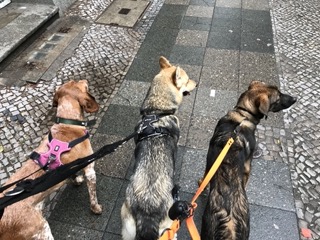
However, in dog-dog communication, this can be very different and can be especially true of dogs being walked on a leash/living in an urban environment where interacting with or meeting unfamiliar dogs may be a daily occurrence, and each interaction, or lack thereof, has to be negotiated between the individuals under circumstances that hinder communication (e.g. leashes/fences). As an example, a dog may look away and tongue flick, e.g. avoidance behavior (Aloff, 2005, p. 122), when spotting another dog approaching to avoid an interaction on the sidewalk, but may be physically unable to create sufficient distance due to the leash and narrow space. This could result in potential conflict that would have otherwise not occurred had the dogs been less restricted in terms of space and ability to communicate. This could lead to dogs starting using other distance-increasing signals proactively, such as lunging (Handelman, 2008, p. 160), which is certainly not an uncommon occurrence in urban environments, and one of the most frequent undesirable behaviors, from the human perspective, I am hired to work with in Berlin and Porto. While people are unlikely to intentionally cause these issues to happen, they certainly can be a byproduct of living in an anthropogenic environment.
Furthermore, it should be noted that who the more “dominant” and “submissive” dog is, can very much depend on the context and the value of a resource for any given dog in a social situation (Bradshaw & Rooney, 2017, p. 138). This may be familiar to people living in a multi-dog household, where one dog highly values a particular resource, like a bone, but has less interest in a dog bed, which may be a high-value resource for another dog in the home. As such, it is important to look at social behavior in context and refrain from generalizing a dog’s behavior in one situation to all possible scenarios, especially in loosely structured social settings like a dog park.
An interesting development in the domestic dog is their increased capacity to communicate with humans and alter their behavior in our presence. One such example is their ability to observe attentional states in humans.
Several researchers have investigated the topic in recent years, and some of the findings are truly fascinating. It has been found that dogs change their approach and posture to a piece of food depending on whether a human is watching the dogs or not (Call et al., 2003, p. 262). Dogs were found to retrieve food less when a human was watching them – and if they did approach the food, they would do so more indirectly (Call et al., 2003, p. 261). Even when the dogs did take food in the presence of a person they would spend more time in an attentive posture, e.g. sitting (Call et al., 2003, p. 261). According to this study, dogs were aware of the human attentional state in the presence of a forbidden piece of food. A separate study by Kaminski et al. (2017) showed similar results regarding dogs altering their behavior in the presence of people, namely their facial expressions. Dogs displayed notably more facial expressions when a person was oriented towards them, compared to the human turning away from the dogs (Kaminski et al., 2017, p. 3). This level of attentiveness towards humans is perhaps of little surprise to people who live with or spend a lot of time around dogs, and who might accidentally leave a plate of food on the table as they leave the room, or another valuable object while their dog is unsupervised.
Domestic dogs are not only capable of being aware of the human attentional state but are also highly skillful at taking cues from us. Unlike wolves, dogs follow human vocal or gestural cues, including pointing, from an early age (Call et al., 2003, pp. 257-258; Ha & Campion, 2018, p. 180). This makes sense as dogs have been, and still are, bred and used for a variety of different working roles, from herding to hunting, which require this exact ability (Call et al., 2003, p. 258). This helps explain why it is often relatively easy for many dog guardians to teach their dog basic skills, without needing to know a great deal about the behavior of their canine companion or learning theory. Dogs are also highly skillful when it comes to playing with humans – the desire to play with us may also be indicative of a tendency to want to cooperate with people (Miklósi, 2015, pp. 689-690). The willingness of dogs to cooperate with humans, especially during hunting, may have been one of the factors behind their domestication (Miklósi, 2015, pp. 695). Wolves, on the other hand, show no such desire to play with humans (Miklósi, 2015, p. 689). As the research shows, dogs likely have a predisposition to pick up on signals given by humans, as well as an interest in communicating and working with us. For dogs that live in anthropogenic environments with regular care provided by humans, this is likely to be an advantageous ability, as they can more easily navigate the human environment to have their basic needs met. However, this skill, or sometimes reliance, on mediation by people does have its disadvantages. Dogs have been shown to look to their humans to help them problem-solve (Ha & Campion, 2018, p. 180). While this can be helpful when it comes to navigating a dog’s triggers or providing reassurance to an anxious dog, it could have negative impacts on a dog’s ability to navigate the world themselves, and, more pertinently, survive without consistent human intervention. These things can happen, even for dogs with a loving caretaker, who might pass away or is no longer able to take care of their canine companion for different reasons. This can turn an otherwise great strength of the domestic dog into a (potentially fatal) weakness in terms of survival.
In conclusion, the modern dog has undergone several significant changes to their ability to communicate as a result of domestication. As dogs have had to adapt to numerous different environments, with varying degrees of human intervention, they have had to be able to develop different strategies among conspecifics and people. Changes to their morphology, communication styles, and general environment have had both positive and negative impacts on their ability to signal their intentions, as well as to respond to signals from others, including humans. Being aware of these adaptations to their communication styles, as well as their social behavior, is of crucial importance in accurately assessing a dog’s behavior in their environment.